
Proust's Last Illusion
And why salon culture is dumb

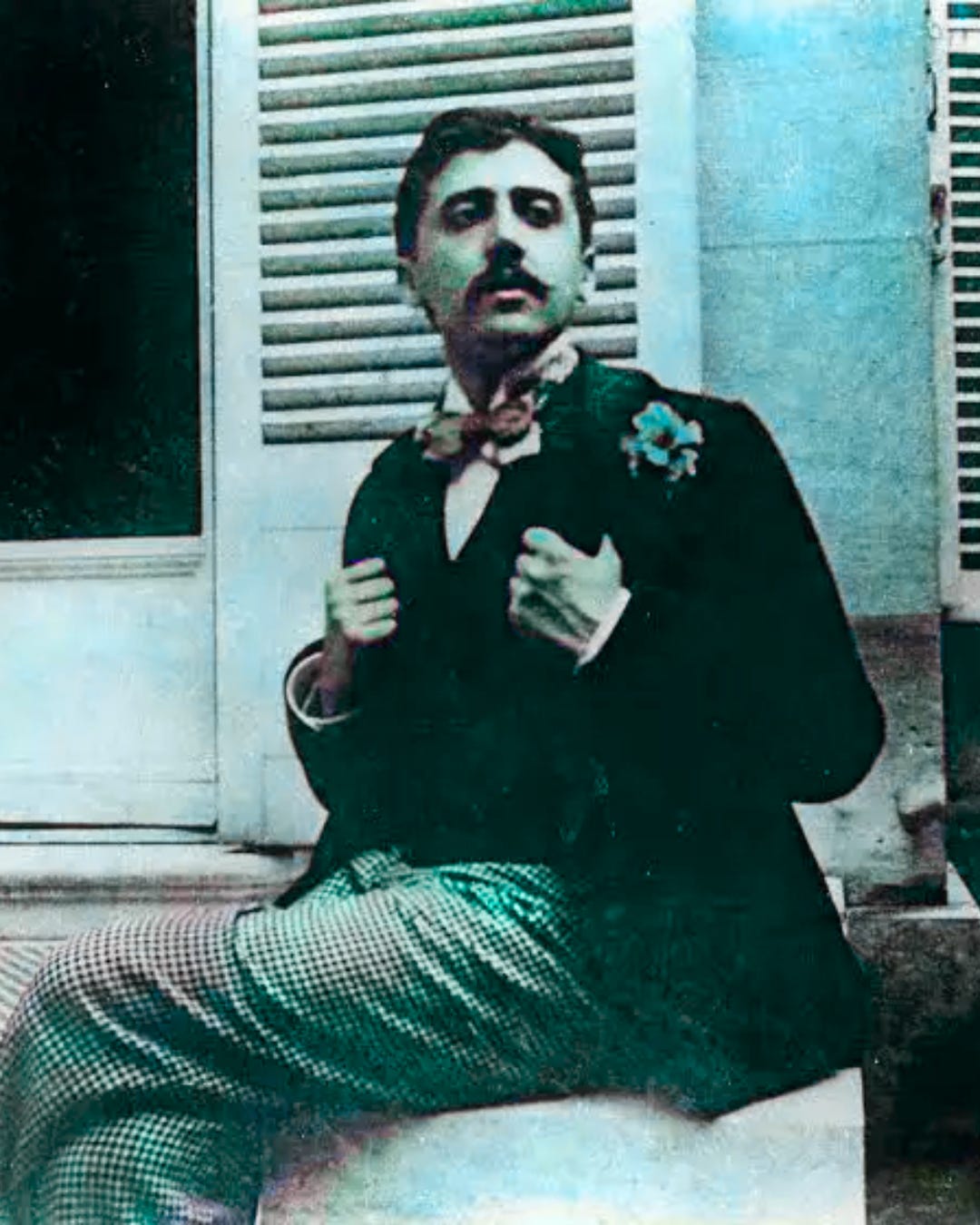
Like most Americans - at least the ones who majored in English - I held a deep respect for the idea of “salon culture” in Paris. In my mind, salons were the settings where artists, writers, poets, and revolutionaries all shared ideas in the company of enlightened benefactors. By the second chapter of Marcel Proust’s The Guermantes Way (1921), I never wanted to hear about salons again.
In the third volume of his epic In Search of Lost Time, Proust spends hundreds of pages describing salons in mind-numbing detail. That’s the point. He wants to show readers that, most of the time, there was nothing special about salons or the nobility that hosted them. These were places of gossiping pseudo-intellectuals, the status hungry and the status-obsessed. Less cultural enlightenment, more red carpet afterparty.
The narrator’s disappointment becomes our own. Especially after the reader endures dinner parties full of meaningless quips, rumors, humblebrags, and even erroneous literary references from a rotating cast of nobles who gather around a dinner table and try to impress each other and call it a salon.
What keeps the narrator coming back? What keeps us interested in the lives of nobility?
Proust explains it this way:
We are attracted by any life which represents for us something unknown and strange, by a last illusion still unshattered.
The people, places, and things that we idolize or villainize or deify in our imagination are, in fact, entirely separate from the experience we have of them in real life. We might be obsessed with a celebrity or artist or ideologue, but as soon as we meet them, they might be the most boring or shallow or callous person in the world. We are not obsessed with them. We’re obsessed with the idea of them.
The conundrum, Proust observes, is that our favorite illusions often don’t remain shattered. They come back together, piece by piece, as soon as we leave that distasteful reality behind.
“This tyranny of reality which confronts us, this self-evidence of the lamplight which turns the already distant dawn as pale as the faintest memory” disappears again as soon as we’re safely removed from it.
In other words, the daft Queen, the clueless CEO, the charming celebrity, the boring artist all safely fade back into the illusion that we had as soon as they’re out of our sight. The legend is what we decide to keep alive in our mind, rather than the impression. Even if we experience something totally different on the outside, our inner life remains unwavering.
As with all of Proust, he waits a few hundred pages to make his final point.
When the Duchess Guermantes is inviting a nobleman to Italy, he refuses. She’s on her way out the door, headed for a dinner party.
“Give me in one word the reason why you can’t come to Italy,” the Duchess put it to Swann as she rose to say good-bye to us.
“But, my dear lady, it’s because I shall then have been dead for several months.”
…
“What’s that you say?” cried the Duchess, stopping for a moment on her way to the carriage and raising her beautiful, melancholy blue eyes, now clouded by uncertainty. Placed for the first time in her life between two duties as incompatible as getting into her carriage to go out to dinner and showing compassion for a man who was about to die, she could find nothing in the code of conventions that indicated the right line to follow; not knowing which to choose, she felt obliged to pretend not to believe that the latter alternative need to be seriously considered, in order to comply with the first, which at the moment demanded less effort, and thought that the best way of settling the conflict would be to deny that any existed. "You’re joking,” she said to Swann.
The noble is terminally ill. They’ll never see each other again. The Duchess heads off to the party. There are no hard feelings.
Because, caught up within the idea of the salon, the Duchess believes that the social obligation of it all is far more important than a single life. She chooses to leave another illusion unshattered, that final illusion, and pretends that her friend isn’t sick, won’t be dead, will be there for the next party, because that’s where we all should be.
This makes us wonder what illusions of life that we shatter and what we choose, consciously, to keep in place. Because a life of illusion is simply more real than the reality of mortality outside it.
Love that pull-quote at the end. People are seldom more cruel than when they are blindly following social conventions to avoid discomfort, and you and Marcel make that point perfectly.
I'd always imagined salons more as organic artistic events, not as elite-sponsored chances for Society to navel-gaze. Another illusion shattered 😄
💙